












































 By
By
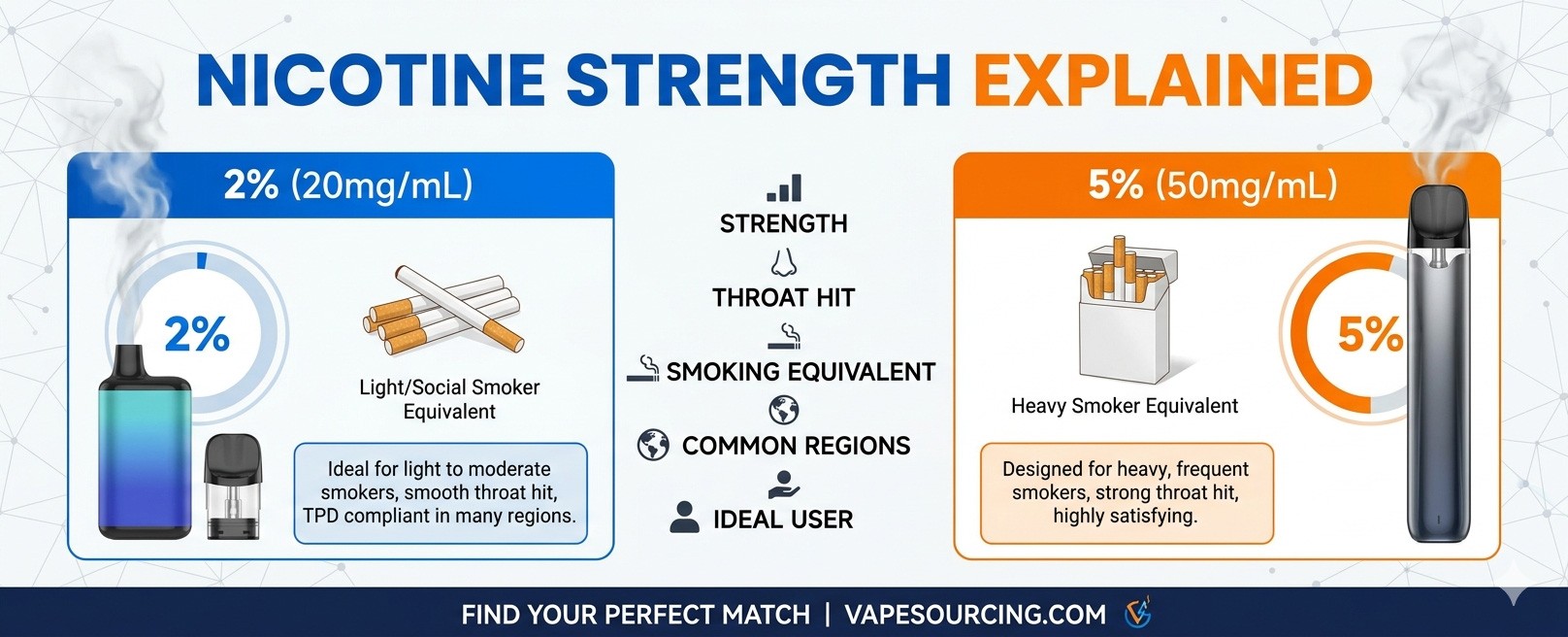
For many transitioning from traditional combustible cigarettes to vaping, or for experienced vapers moving from sub-ohm kits to disposables, the numbers on the packaging can be confusing. The most common debate centers around 2% vs. 5% nicotine strength.
Understanding these concentrations is more than just a matter of preference; it is essential for managing cravings, ensuring a satisfying "throat hit," and maintaining a safe vaping experience. This guide breaks down the science behind these numbers, compares the two most popular strengths, and provides the technical data needed to make an informed choice.
Understanding the Basics: Percentage vs. mg/mL
Before comparing specific strengths, it is vital to understand how nicotine concentration is measured. Manufacturers generally use two units: milligrams per milliliter (mg/mL) or a percentage (%).
Calculation Formula:
Concentration (mg/mL) = Percentage × 10
- 2% Nicotine: This equals 20mg/mL.
- 5% Nicotine: This equals 50mg/mL.
Most modern disposables and pod systems utilize Nicotine Salts (Nic Salts). Unlike freebase nicotine, salts are pH-balanced with benzoic acid, allowing for higher concentrations to be vaped without the harsh throat hit typically associated with high-strength nicotine.
2% Nicotine (20mg/mL): The TPD Standard and Beyond
In the United Kingdom and the European Union, the Tobacco Products Directive (TPD) limits nicotine strength to a maximum of 2% (20mg/mL). Consequently, this has become the global benchmark for a "medium-high" strength.
Who is it for?
- Social Smokers: Those who smoked fewer than 10 cigarettes a day.
- TPD Compliance: Vapers residing in regions with strict regulatory caps.
- Flavor Seekers: Lower concentrations often allow the complex flavor profiles of the e-liquid to shine through more clearly.
5% Nicotine (50mg/mL): High-Intensity Satisfaction
A 5% concentration is considered very high and is common in the United States and other non-regulated markets. This strength was popularized to mimic the rapid nicotine delivery of a traditional cigarette.
Who is it for?
- Heavy Smokers: Individuals transitioning from a pack-a-day (20+ cigarettes) habit.
- Efficiency Seekers: Those who want to take fewer puffs but receive maximum satisfaction quickly.
- Hand-to-Mouth Habit Reduction: High potency often means users reach for their device less frequently.
Direct Comparison: 2% vs. 5%
| Feature | 2% Nicotine (20mg/mL) | 5% Nicotine (50mg/mL) |
|---|---|---|
| Nicotine Content | 20mg per 1mL | 50mg per 1mL |
| Throat Hit | Smooth to Moderate | Strong / Noticeable |
| Ideal For | Light to Moderate Smokers | Heavy Smokers (Pack+ per day) |
| Regulatory Status | Legal in EU/UK/Canada | Restricted in many regions |
Nicotine Consumption by Cigarette Equivalent
| Device Capacity | Nicotine Strength | Total Nicotine | Cigarette Equivalent (Est.) |
|---|---|---|---|
| 2mL (TPD Pod) | 2% (20mg/mL) | 40mg | ~2 Packs |
| 10mL (Disposable) | 2% (20mg/mL) | 200mg | ~10 Packs |
| 10mL (Disposable) | 5% (50mg/mL) | 500mg | ~25 Packs |
*Note: Estimates are based on total content. Bioavailability varies by device wattage.
Health and Regulatory Perspectives
When discussing nicotine strengths, it is important to reference public health authorities. The Royal College of Physicians and Public Health England have maintained that vaping is at least 95% less harmful than smoking. However, they emphasize that nicotine is the addictive component.
The FDA (U.S. Food and Drug Administration) continues to monitor high-strength nicotine products closely. High concentrations like 5% should be handled with care to avoid nicotine toxicity.
Find Your Perfect Strength Today!
Explore our premium collection of 2% and 5% nicotine disposables and pod systems.
Shop at VapesourcingFrequently Asked Questions
1. Is 5% nicotine a lot for a beginner?
Yes. For someone who has never smoked or vapes very little, 5% is extremely high and likely to cause discomfort. It is designed specifically for heavy smokers transitioning to vaping.
2. Why is 2% the limit in some countries?
The 20mg/mL limit (2%) was established by the TPD in the EU/UK to balance consumer satisfaction with safety, aiming to reduce addiction risk and accidental poisoning.
3. Does higher nicotine mean better flavor?
Usually, no. High nicotine concentrations can sometimes have a slightly peppery taste. Lower strengths like 2% often allow the flavoring concentrates to be more prominent.
4. Can I mix 0% and 5% to get a lower strength?
In refillable pod systems, yes. Mixing equal parts of 0mg and 50mg (5%) e-liquid will result in a 25mg (2.5%) strength. This is an effective way to taper down.
5. How many puffs of 5% nicotine is equal to a cigarette?
Roughly 10 to 15 puffs of a 5% disposable are estimated to deliver a similar amount of nicotine to the blood as one combustible cigarette.






comments